
The Next Food Recall May Already Be Inside Today’s Workaround
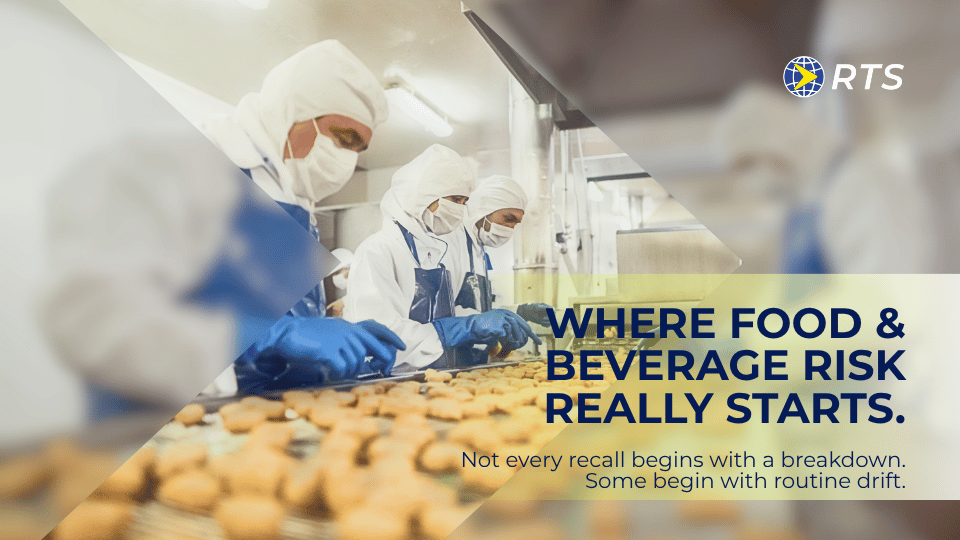
Food and beverage plants are built to keep moving
-
That is the reality every operations leader understands. Production schedules change. Labor availability shifts. Materials arrive late or behave differently than expected. Equipment behaves differently after sanitation than it did before. Customers want flexibility. Retailers want consistency. Finance wants efficiency. Quality wants control. And through all of it, the plant is expected to run safely, reliably, and profitably.
-
That pressure is not new. What is changing is how little room there is for weak execution discipline.In food and beverage, small deviations can travel quickly. A missed check during a changeover, a labeling assumption, an informal workaround, a maintenance issue that keeps being “managed,” or a process standard that varies by shift may not create a crisis immediately. The line may still run. Orders may still ship. The numbers may still look acceptable.
-
Until they do not.
By the time a problem becomes visible as a customer complaint, quality hold, rejected shipment, retailer escalation, or recall, it has often been present in the operation for some time. It was not invisible. It was normalized.
That is the uncomfortable part.
Many food manufacturing failures do not begin as dramatic breakdowns. They begin as reasonable decisions made under pressure. A team adjusts because the schedule changed. A supervisor makes a call because the standard does not quite fit the situation. An operator compensates because the equipment is behaving differently. Quality adds an extra manual check because the normal routine is not catching the issue early enough.
Individually, these decisions may be practical. Collectively, they can become the real operating system of the plant.
This is where RTS often enters the conversation with food and beverage leaders. Not at the level of slogans or broad transformation language, but at the point where leaders need to understand how work is actually being executed: how batches move, how quality checks are completed, how critical control points are monitored, how changeovers are governed, how genealogy is captured, how line clearance is verified, and how much of the operation still depends on memory, manual follow-up, or informal coordination.
Because in food and beverage, the gap between the defined process and the real process is where risk grows.
Food safety is becoming a test of execution discipline
Food safety has always been central to the industry. What is changing is the expectation for proof, speed, and traceability.
The FDA’s Food Traceability Rule originally had a compliance date of January 20, 2026. The FDA later proposed extending the compliance date by 30 months to July 20, 2028, and subsequent federal direction stated that FDA should not enforce the rule before that same date. On paper, that gives manufacturers more time. For operations leaders, the more important question is what that time will be used for.
A delay can become preparation. Or it can become another reason to postpone difficult work.
Traceability is sometimes discussed as a regulatory requirement. Inside a plant, it is something more practical. It is the ability to reconstruct what happened when pressure is high and the answers matter.
Which material was used? Which batch was affected? Which line ran it? Which operator action was recorded? Which quality result released or held the product? Was the relevant control monitored correctly? If there was a deviation, was the response completed and verified? Was the issue contained quickly, or did the team have to piece together the story after the fact?
Those questions are not just about records. They reveal whether execution is controlled.
HACCP belongs in this conversation, but not as a separate compliance topic. It is one of the clearest examples of why execution discipline matters. FDA describes HACCP as a management system for analyzing and controlling biological, chemical, and physical hazards across production, handling, manufacturing, distribution, and consumption.
That definition is important because HACCP is not a binder on a shelf. It is supposed to shape how risk is identified, monitored, controlled, corrected, verified, and documented in the flow of work.
The issue for many plants is not whether a HACCP plan exists. The issue is whether the operation can execute it consistently on a difficult day.
A critical control point is only meaningful if monitoring happens at the right time, in the right way, with the right response when something falls outside the limit. A corrective action is only meaningful if it is followed, documented, verified, and understood beyond the person who handled the issue. A record is only meaningful if it reflects what happened, not what had to be reconstructed later.
A plant with strong execution discipline does not need to scramble to understand its own history. Batch records, genealogy, HACCP monitoring, quality checks, operator workflows, and exception handling tell a consistent story because the work itself is structured, visible, and owned.
A plant with weak discipline may still have records, but those records often require interpretation. Someone must explain what really happened. Someone must remember the workaround. Someone must connect the missing context between production, quality, sanitation, maintenance, and planning.
That is a fragile position for any food manufacturer.
The strongest operations teams will not treat traceability or HACCP as paperwork. They will treat both as readiness tests.
Recalls rarely come out of nowhere
Recall data continues to show how operational risk becomes public. In USDA-regulated recalls reported for 2025, foreign material was the leading cause, followed by undeclared allergens. Other causes included production without inspection, import violations, Listeria contamination, unapproved substances, STEC contamination, and misbranding.
For a plant leader, these categories are not abstract.
Foreign material risk points back to equipment condition, inspection reliability, maintenance standards, cleaning practices, and escalation discipline. Allergen and labeling risk points back to changeover control, packaging verification, line clearance, material segregation, sanitation effectiveness, and the quality of handoffs between production, sanitation, maintenance, quality, and planning.
A recall may be announced in a press release, but it is usually built much earlier in the ordinary flow of work.
That does not mean people were careless. In most plants, people are working hard to prevent exactly these issues. The problem is that hard work can mask weak systems for a long time. Experienced operators catch problems before they travel. Supervisors intervene. Quality teams add checks. Maintenance keeps aging assets running. Everyone adapts.
Adaptation is part of operations. But when adaptation becomes the permanent answer, the plant starts depending on heroics instead of discipline.
That is when risk becomes harder to see.
RTS has seen this pattern directly in food manufacturing environments. In one chocolate production case, the manufacturer needed to detect internal defects before chocolate enrobing because previous inspection methods relied heavily on what could be seen externally. The operational issue was not simply inspection. It was that hidden defects were moving too far through the process before they could be reliably identified and rejected.
That pattern is familiar across food and beverage.
The defect is not always created where it is finally found. The risk is not always visible where it eventually becomes expensive.
Labor pressure is exposing what the system really depends on
Labor pressure remains one of the most practical constraints in food and beverage operations. But the deeper issue is not only whether enough people are available.
The deeper issue is how much the plant depends on specific people to function well.
Every operations leader knows the difference between a shift that runs smoothly because the system is strong and a shift that runs smoothly because the right people happened to be there. The second version can look good in the numbers, but it does not scale. It is vulnerable to absenteeism, turnover, retirements, overtime fatigue, and growth.
This matters because so much food and beverage risk lives in routine work. Changeovers, sanitation, allergen control, packaging verification, inspection checks, rework decisions, sampling, batch release, CCP monitoring, and escalation steps all depend on consistency.
If those routines change depending on who is on shift, the operation is not as stable as it appears.
Training helps, but training alone is not enough. The real question is whether the work is structured in a way that makes good execution repeatable.
That is where systems of execution matter. Not as technology for its own sake, but as the operating backbone that helps ensure the right steps happen in the right order, with the right checks, the right approvals, and the right visibility when something does not go to plan.
A mature operation does not remove judgment from the plant. It protects people from having to use judgment to compensate for preventable confusion.
Cost pressure makes weak priorities expensive
Food manufacturers continue to invest in equipment, training, and operational improvement because leaders know they cannot simply wait for conditions to improve. Plants still need capacity, skills, reliability, and better ways of working.
But cost pressure changes the standard for decision-making. It makes unfocused activity more expensive.
A plant can be busy improving and still remain reactive. New equipment may increase capacity, but it will not solve a planning discipline issue. More inspection may catch more defects, but it will not remove the source of variation. More training may help, but it will not create consistency if every shift is still operating from a slightly different version of the standard.
This is where many operations teams get trapped. They are not short on effort. They are short on clarity.
The plant has downtime to reduce, waste to control, changeovers to improve, labor to stabilize, complaints to address, maintenance backlogs to manage, and yield losses to explain. Every issue has a cost. Every department has a priority. Every meeting produces another action.
But not every problem is equally important.
Stronger operations teams are better at identifying the few conditions that create the most instability downstream. They do not confuse the loudest problem with the most important one. They look for the constraint beneath the symptoms.
That discipline matters because food and beverage plants can spend a great deal of energy managing the same problems month after month. The work feels urgent, but the system does not get stronger.
At some point, leadership must ask whether the plant is improving or simply becoming better at reacting.
Packaging and changeovers are where complexity becomes real
Packaging and changeovers deserve more attention than they often receive in strategic conversations.
They are easy to underestimate because they look routine. Plants perform them every day. Teams know the sequence. Supervisors know the risks. Quality knows what must be checked. Maintenance knows where issues tend to appear.
But in today’s food and beverage environment, routine does not mean simple.
More SKUs, shorter runs, customer-specific formats, allergen considerations, promotional packaging, and schedule changes have made changeovers one of the most important control points in the plant. This is where business complexity becomes operational risk.
A changeover is not just the time between products. It is the moment when the plant has to prove that it can stop one reality and safely begin another.
The right materials need to be present. The wrong materials need to be gone. The line needs to be cleared. Labels and packaging need to match the product. Sanitation and allergen requirements need to be completed properly. The team needs to know what changed from the previous run and what cannot be assumed.
When changeover control is weak, the plant may still restart on time. But it restarts with more risk than leadership can see.
This is where HACCP, quality execution, and day-to-day operating discipline intersect. A hazard analysis may correctly identify allergen cross-contact, foreign material risk, or labeling risk. But if the changeover routine depends on memory, if verification happens outside the actual flow of work, or if exceptions are not visible quickly enough, the control is weaker than it looks on paper.
This is why line clearance, electronic batch records, operator workflows, quality execution, LIMS integration, CCP monitoring, and plant-floor visibility are not simply system features. They are expressions of operational discipline. They determine whether critical steps are controlled in the flow of work or reconstructed later through meetings, emails, and memory.
For operations leaders, the question is not whether the plant has procedures.
The question is whether the procedure governs the moment when risk enters the process.
The real risk is normalized drift
Most plant leaders can see obvious failure. A line is down. A batch is on hold. A customer has complained. A shipment is late. A supplier issue has disrupted the schedule.
These events get attention because they interrupt the business.
Operational drift is harder to see because it often allows the business to continue.
The plant still runs, but the way work actually happens slowly separates from the way work is supposed to happen. A temporary workaround becomes normal. A recurring defect becomes familiar. A standard varies slightly by crew. A known issue is discussed in meetings but never truly removed. A supervisor carries important knowledge that never becomes part of the operating system.
Nothing about this feels like a crisis while it is happening.
In fact, it can feel like competence. The team knows how to get through the day. People understand where the weak spots are. They know which checks need extra attention. They know who to call when something does not look right.
That kind of experience is valuable. But it can also hide the fact that the process itself is not strong enough.
The danger of drift is that it gives leaders the impression of stability while risk is accumulating underneath. The operation appears to be coping, but coping is not the same as control.
Eventually, the gap becomes visible. A complaint exposes it. An audit exposes it. A recall exposes it. A customer visit exposes it. A key employee leaves and the plant suddenly realizes how much knowledge was living in one person’s head.
That is why mature operations pay attention to the weak signals before they become business events.
They do not wait for failure to become official.
What stronger food operations do differently
Strong food and beverage operations are not problem-free. No serious plant is.
They still deal with supplier variation, labor gaps, equipment issues, sanitation pressure, schedule changes, and customer demands. The difference is that they do not allow recurring instability to become part of the culture.
When a workaround appears, they want to understand why it was needed. When a quality issue repeats, they treat it as a signal from the process, not an isolated incident. When performance varies by shift, they look beyond individual behavior and examine standards, training, handoffs, and supervision. When meetings review the same losses week after week, they question whether the management routine is actually changing anything.
This is where operational maturity becomes practical.
It is not a slogan. It is not a program name. It is the ability of the plant to see what is happening, understand why it is happening, and respond in a way that makes the operation stronger instead of just getting through the day.
For food and beverage leaders, that maturity increasingly depends on how well execution is structured. Batch records need to reflect reality. Genealogy needs to be reliable. Quality checks and CCP monitoring need to happen at the right point in the process. Operator workflows need to reduce ambiguity. Exceptions need to be visible before they become customer issues. Changeovers need to be controlled without depending on the memory of the most experienced person on shift.
The best operations leaders tend to ask questions that cut through noise.
Would two shifts make the same decision with the same information? Can a new supervisor understand how this process is supposed to run without relying on informal explanations? Are we managing the same losses repeatedly instead of eliminating them? Could we explain a quality issue from cause to containment without depending on one person’s memory? Can we prove that critical controls were monitored correctly when production was under pressure? Are our daily meetings changing the plant, or only describing it?
These questions are uncomfortable because they reveal how much of performance is structural and how much is personal.
A plant is not mature because it performs well on a good day. A plant is mature when it can hold standards, expose risk, and recover quickly when the day becomes difficult.
And in food and beverage, difficult days are not exceptions. They are part of the operating environment.
Where RTS fits
Food and beverage manufacturers are not facing one isolated challenge. They are facing a maturity test.
Traceability expectations, recall exposure, labor pressure, HACCP execution, packaging complexity, cost constraints, and customer demands are all pointing toward the same issue: plants need stronger ways to see, govern, and sustain execution.
That is where RTS supports food and beverage leaders.
RTS works at the intersection of operational discipline and manufacturing execution, helping organizations move from informal adaptation to governed, repeatable ways of working. In food and beverage environments, that means helping leaders strengthen the practical foundations that protect performance: batch execution, genealogy, quality workflows, CCP monitoring, line clearance, changeover control, operator guidance, LIMS integration, plant-floor visibility, and the governance needed to make those disciplines hold under production pressure.
The goal is not to add complexity to an already pressured operation. It is to help leaders understand where the plant is truly in control, where execution still depends too heavily on memory or manual intervention, and where risk is being absorbed by people instead of managed by the operating system.
RTS has operated in manufacturing environments since 1992 and has supported more than 3,000 projects across industrial organizations. Its work in food and beverage is grounded in a simple reality that plant leaders recognize immediately: the shopfloor exposes the difference between intention and execution.
The next major issue may not begin with a dramatic breakdown. It may already be present in a workaround that feels normal, a recurring problem that feels manageable, or a control that looks strong in the plan but depends too heavily on manual discipline during production.
That is the question operations leaders need to bring back to their teams.
Not simply: are we compliant?
But: can we prove control when the plant is under pressure?
Because if the answer depends too heavily on memory, heroics, and informal workarounds, the plant may be more exposed than the numbers suggest.
For more information, contact:
Vic Briccardi, Partner
RTS Consulting – Automation
Email: vic@rtsperfectplant.com
Website: www.rtsperfectplant.com